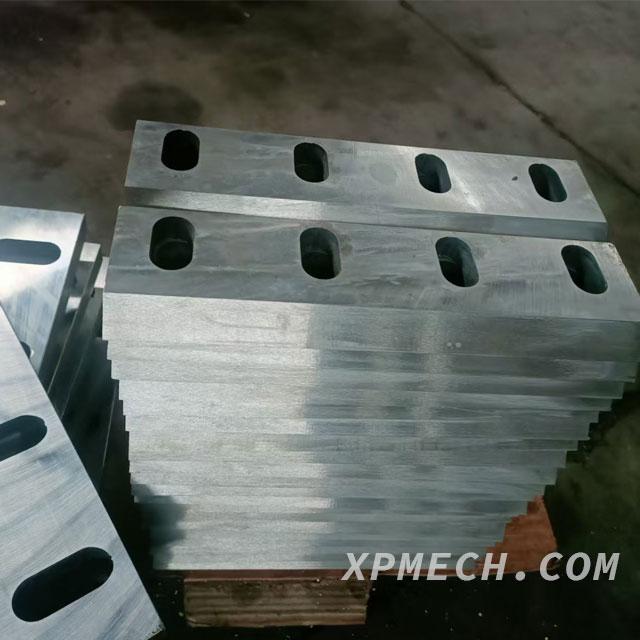

Choosing the Right Shredder Blades: Doubling Crushing Efficiency
In industries such as resource recovery, solid waste treatment, plastics recycling, and agricultural processing, shredders serve as indispensable core equipment. The shredder blades, in particular, act as the machine’s “core teeth”—their performance directly determines production efficiency, energy consumption levels, and even overall operating costs. Many industry professionals face common frustrations: blades that lack wear resistance, leading to frequent replacements that delay production schedules; dull cutting edges that result in uneven particle sizes, thereby hindering subsequent processing; and poor compatibility, leaving operators helpless when faced with specialized materials. In reality, simply selecting the right set of high-quality shredder blades can effortlessly resolve these pain points.
The core competitive advantage of premium shredder blades is never merely “low cost,” but rather “durability, efficiency, and adaptability.” Unlike the generic steel used in standard blades found on the market, high-end blades typically utilize high-wear-resistance, high-toughness alloy steels—such as Cr12MoV, D2, and H13K—or even cemented carbides like YG8 and YG20. These materials undergo specialized heat treatment processes to ensure both exceptional cutting-edge sharpness and enhanced resistance to impact and abrasion. For instance, when processing the plastic casings of discarded home appliances, high-quality Cr12MoV blades can operate continuously for over 800 hours—extending their service life by more than 45% compared to standard products—thereby significantly reducing replacement frequency and minimizing downtime losses.
Adaptability serves as yet another key advantage of premium blades. Different industries and different materials impose vastly different requirements on shredder blades: the agricultural sector, when processing crop stalks and produce, requires wear-resistant, cost-effective manganese steel blades; the environmental protection sector, when handling solid or hazardous waste, demands high-hardness alloy blades that offer superior corrosion and impact resistance; the food processing sector mandates the use of food-grade 304 or 316 stainless steel blades to ensure strict hygiene and regulatory compliance; and the plastics recycling sector requires blades featuring anti-stick designs to prevent material adhesion from compromising operational efficiency. A superior blade is one that not only accommodates standard materials but also offers customized solutions for specialized operating conditions—for instance, by optimizing cutting-edge angles and applying anti-stick coatings to handle challenging materials such as rubber tires and cables. This approach boosts shredding efficiency by over 30%, effectively resolving common issues like material sticking to blades and machine clogging.
Beyond material composition and compatibility, meticulous design details are equally critical to the user experience. High-quality blades feature precisely engineered cutting-edge angles paired with scientifically designed chip-evacuation grooves; this configuration minimizes material slippage to ensure greater shredding uniformity, while simultaneously reducing energy consumption per ton of processed material by 15% to 20%—thereby truly achieving both cost reduction and efficiency gains. Furthermore, a rigorous quality control system is indispensable; from raw material intake to finished product dispatch, comprehensive process monitoring ensures that every single blade exhibits uniform hardness and precise dimensions. This guarantees smooth operation upon installation, preventing issues such as equipment vibration or excessive noise caused by blade irregularities.
As we look toward 2026, with various industries placing ever-increasing demands on cost-efficiency and sustainable development, the criteria for selecting shredder blades have shifted decisively—moving beyond mere “usability” to prioritize “superior performance” and “durability.” Rather than frequently replacing inexpensive blades—and enduring the resulting production delays and financial waste—it is far more prudent to make the right choice the first time by investing in a premium product. This strategy not only minimizes replacement costs and downtime losses but also enhances shredding efficiency and the quality of the final output, proving to be the more cost-effective solution in the long run.
Whether your operations involve plastics recycling, resource recovery, agricultural processing, or industrial manufacturing, we can provide tailored shredder blade solutions designed to meet your specific operating conditions and material characteristics. From standard models to fully customized products—and encompassing everything from material selection to after-sales maintenance—we offer a comprehensive, one-stop service to fulfill all your requirements. Choose the right shredder blades to ensure every shredding task is executed with maximum efficiency and peace of mind, thereby empowering your production line to achieve steady, continuous growth!