

What is the Best Material for Shredder Blades?
There is no single, absolutely “best” steel material for shredder blades; the optimal choice depends on the type of material you intend to shred (such as plastics, metals, wood, etc.) as well as your specific operating conditions. The core principle is to match the steel’s hardness and toughness to the material being processed while also taking cost-effectiveness into account.
Core Material Selection Principles: Matching Steel to the Material Being Shredded
- Material Hardness Determines Steel Hardness: For shredding soft plastics (such as PE or PP), choose a steel with moderate hardness (HRC 52–55) and good toughness. For shredding hard metals, tires, or glass-fiber-reinforced plastics, steel with extremely high hardness (above HRC 58) and excellent wear resistance is required.
- Balancing Wear Resistance and Impact Resistance: Wear resistance ensures a long blade lifespan, while impact resistance prevents the blades from chipping or fracturing when shredding large or hard materials.
- Balancing Cost and Performance: General-purpose materials are lower in cost, whereas high-performance specialty steels or cemented carbides come at a higher price; the choice should be made based on your production scale and budget.
Comparison of Common Steel Properties and Application Scenarios
Listed below are several mainstream steel materials used for shredder blades, along with their characteristics, to assist you in making a preliminary selection based on your specific needs:
·65Mn (Spring Steel): Low cost, good elasticity, and moderate wear resistance. With a heat-treated hardness of approximately HRC 52–55, it is suitable for standard plastic shredders and for processing non-high-strength materials.
·9CrSi (Alloy Tool Steel): Features relatively high hardness (HRC 55–58) and good wear resistance; however, it is somewhat brittle and possesses slightly lower impact resistance. It is suitable for processing soft waste materials or for general plastic recycling applications.
·Cr12MoV / SKD-11 (High-Carbon, High-Chromium Cold Work Tool Steel): Possesses excellent wear resistance and can achieve a hardness of over HRC 62. It exhibits minimal deformation during quenching, making it suitable for precision molds and high-wear applications. It is a commonly chosen premium material for blades in plastic granulators (particularly those processing hard plastics) and shredders.
·High-Speed Steel (e.g., W18Cr4V, SKH-9): Combines high hardness with good toughness. Its wear resistance surpasses that of standard tool steels, making it suitable for granulating medium-hardness materials (such as corn cobs) or highly tough, soft materials (such as plastic films and bags).
·Carbide (Tungsten Steel): Offers the highest hardness and superior wear resistance; however, it suffers from poor toughness, high cost, and susceptibility to cracking. It is primarily used for granulating extremely hard or highly abrasive materials (such as glass-fiber-reinforced plastics) and is not suitable for applications involving high impact loads.
·Other Specialty Tool Steels (e.g., DC53, H13): These steels prioritize different attributes regarding hardness, toughness, and resistance to chipping. For instance, DC53 offers superior toughness compared to SKD-11, while H13 boasts strong impact resistance; these are frequently used for shredding metals or complex composite materials.
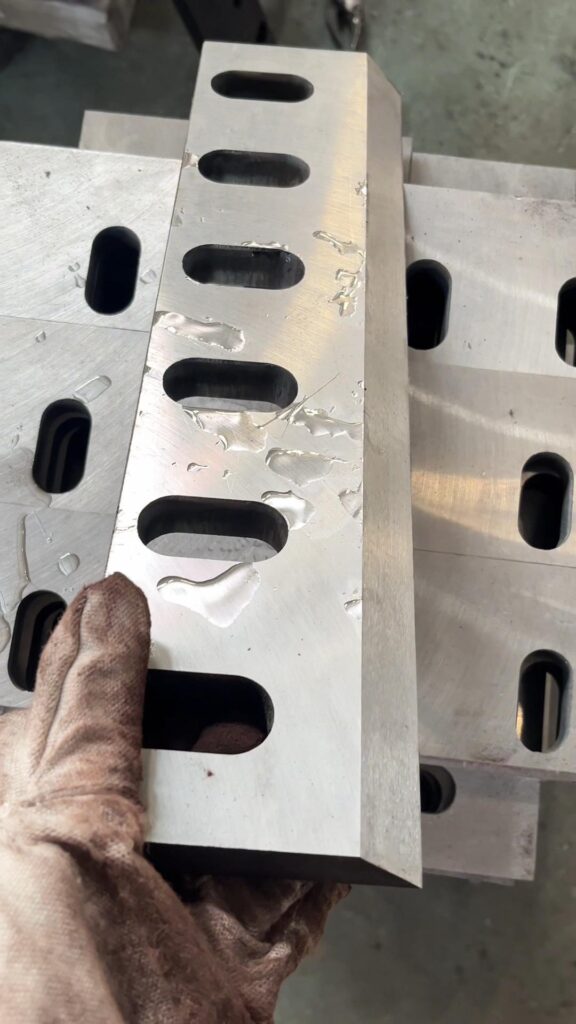
Recommended Material Selection for Various Granulating Materials
Based on the principles outlined above, the following provides more specific recommendations for blade material selection across different types of granulators:
Plastic Granulators
General-Purpose Plastics (ABS, PP, PET, etc.): Recommended materials include 9CrSi (economical and practical) or SKD-11/Cr12MoV (high-performance and durable).
Soft, Tough Materials (Plastic Films, Bags): High-Speed Steel (e.g., SKH-9) is recommended for its ability to maintain a sharper cutting edge.
Highly Abrasive Plastics (Glass-Fiber-Reinforced, Flame-Retardant Materials): SKD-11 or Carbide is recommended to ensure extended service life. Metal / Tire Shredders
Single-Shaft Shredders (High Hardness, Wear-Resistant, Impact-Resistant): Commonly utilize Cr12MoV, D2, or DC53.
Dual-Shaft / Quad-Shaft Shredders: Commonly utilize 55SiCr or H13.
For Shredding Extremely Hard Materials (e.g., High-Strength Steel): Requires the selection of specific materials with high impact resistance and toughness, such as H13Ni or HMB.
Wood / Biomass Shredders (e.g., Corn Cobs)
High-Speed Steel (HSS): Offers a balance between wear resistance and toughness, making it a highly practical choice.
Carbide: Suitable for applications requiring high hardness during prolonged, continuous operation.
Heavy-Duty Crushers (For Processing Large or High-Strength Materials)
Blades require higher hardness (HRC 55–58); materials such as SK5, T10, 9CrSi, and 6CrW2Si are commonly selected.