

Applications of Serrated Blades
Serrated blades are industrial cutting tools featuring a saw-toothed structure; they are widely utilized across numerous industries, with the primary objective of enhancing the precision, efficiency, and cut quality of material slitting and processing operations. Based on publicly available information, their main applications can be summarized as follows:
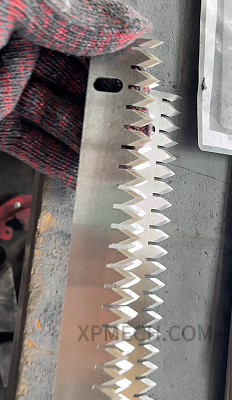
Key Application Areas and Functions
- Paper Industry: Used for the slitting, trimming, perforating, and fixed-length cutting of products such as toilet paper, paper tubes, and cardboard boxes, ensuring clean, smooth cuts free of burrs.
- Packaging Industry: Compatible with equipment such as bag-making machines, carton sealers, bagging machines, and filling/packaging systems; enables point-break, perforated, or decorative cutting of materials—including adhesive tapes, films, plastic bags, and aluminum foil—facilitating easy tearing while maintaining aesthetic appeal.
- Rubber and Plastics Processing: Employed in processes such as tire trimming, conveyor belt slitting, plastic granulation, and shredding; the serrated design allows for the effective gripping and shearing of elastic or viscous materials.
- Steel and Metallurgy: Integrated into equipment such as slitting lines and strip cutters to perform high-precision longitudinal slitting of metal sheets, achieving thickness tolerances as tight as ±0.0005 mm.
- Food Processing: Used for slicing soft or elastic food products—such as ham, cheese, and bread—where the serrated structure provides a stable grip on the food item, preventing slippage, stretching, or uneven slice thickness.
- Leather and Textiles: Facilitates the slitting and cutting of leather as well as the cutting of various fabrics, producing clean, neat edges free of fraying or burrs.
- Electronics and Film Industry: Utilized for the high-precision slitting of materials such as copper foil, aluminum foil, magnetic tape, and protective films, requiring cutting edges with micron-level precision.