

Manufacturing Process of Plastic Crusher Blades
As a core component of plastic crushing equipment, the manufacturing process of plastic crusher blades directly determines their performance, service life, and crushing efficiency. The following are common manufacturing process steps:
Material selection is the first step in manufacturing high-quality plastic crusher blades. High-strength, high-hardness steel with good wear resistance and toughness is typically selected, such as high-speed steel and alloy tool steel. High-speed steel has excellent red hardness, maintaining good cutting performance even at high temperatures, making it suitable for long-term, high-intensity plastic crushing operations. Alloy tool steel, by adding specific alloying elements such as chromium, molybdenum, and vanadium, enhances the blade’s hardness, wear resistance, and corrosion resistance, enabling it to cope with various complex plastic crushing environments. For example, when crushing plastic raw materials containing corrosive additives, alloy tool steel blades effectively resist corrosion, extending their service life.
After the materials are prepared, the forging process begins. Forging improves the microstructure of the steel, making the internal grains finer and more uniform, thus improving the overall mechanical properties of the blade. Through repeated forging, the steel billet is shaped into a blank close to the final shape of the blade, removing internal defects such as porosity and air bubbles, while simultaneously ensuring a uniform distribution of second phases like carbides, laying a solid foundation for subsequent machining and heat treatment.
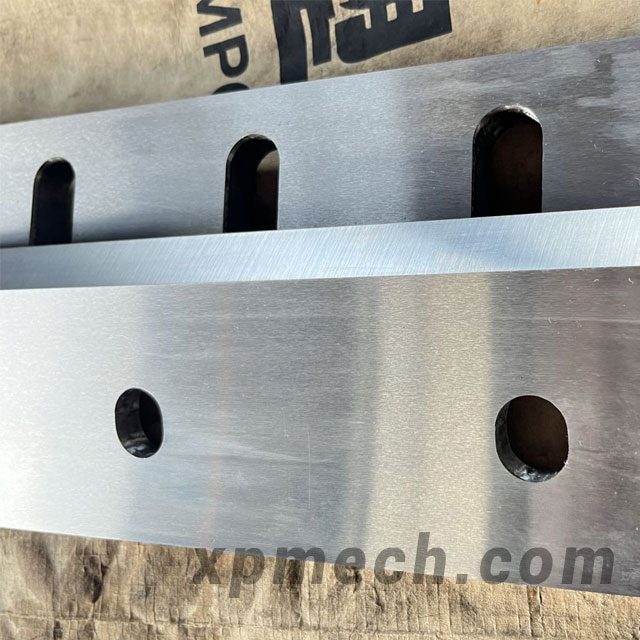
The forged blank requires machining. First, rough machining is performed, using cutting equipment to cut the blank into its approximate shape. Then, precise milling and drilling operations are carried out on CNC machining centers or conventional machine tools to obtain the precise dimensions and structural features of the blade, such as mounting hole positions. During this process, strict control of machining accuracy is required; parameters such as the blade’s cutting edge angle and thickness tolerance must meet design requirements, as these parameters directly affect the blade’s crushing effect and cutting force distribution.
Heat treatment is a crucial step in the manufacturing process of plastic crusher blades. Through heat treatment processes such as quenching and tempering, the hardness and wear resistance of the blade can be significantly improved, while its toughness is adjusted. During quenching, the blade is rapidly heated above the critical temperature and then quickly cooled, causing the steel to acquire a martensitic structure, thereby significantly increasing hardness. However, quenched blades are relatively brittle and require tempering. Tempering eliminates quenching stress, appropriately reduces hardness, and improves toughness, resulting in better overall performance. For example, for high-speed steel blades, the quenching temperature is generally between 1200-1300℃, while the tempering temperature is adjusted according to specific requirements, involving multiple tempering processes between 500-600℃.
After heat treatment, the blades also require surface treatment. Common surface treatment methods include nitriding and coating. Nitriding forms a high-hardness, wear-resistant, and corrosion-resistant nitride layer on the blade surface, further improving the surface properties. The nitride layer also reduces the coefficient of friction between the blade and the plastic, reducing blade sticking. Coating involves applying a hard coating such as TiN or TiC to the blade surface. These coatings have high hardness, a low coefficient of friction, and good chemical stability, effectively protecting the blade substrate and improving its wear resistance and service life. Especially when crushing high-hardness, high-viscosity engineering plastics, surface-treated blades exhibit superior performance.
Finally, the manufactured plastic crusher blades undergo rigorous quality testing. This includes hardness testing, dimensional accuracy inspection, and visual inspection. Only blades that meet all standards are put into use, ensuring stable and efficient performance during plastic crushing and fulfilling the plastics processing industry’s requirements for crushing quality and production efficiency.