

Detailed Explanation of Blade Adjustment Techniques and Spacer Parameters for Slitting Shears
As the core component of slitting shears, the material selection of slitting shear blades is crucial. Commonly used high-quality tool steels and alloy steels include 5CrW2Si, 6CrW2Si, Cr12Mov, LD, H13, W18Cr4V, and H13K. These materials ensure blade sharpness, wear resistance, and a smooth cut, resulting in a burr-free product and excellent heat dissipation.
In addition, spacers (gap washers) serve as separators and play a crucial role in slitting shears. Technical parameters include: blade outer diameters ranging from Φ800-Φ1000, with thicknesses from 3mm to 60mm; spacer thicknesses ranging from 0.8mm to 200mm; and a flat thickness tolerance of no more than 0.003mm. The spacers are made of 65Mn and chrome-plated for corrosion resistance. High-quality steel is selected for each metal coil material and thickness. Heat treatment methods include vacuum hardening, high-frequency hardening, or salt furnace hardening, depending on requirements. Quality control focuses on material selection, heat treatment, and precision to ensure superior product performance.
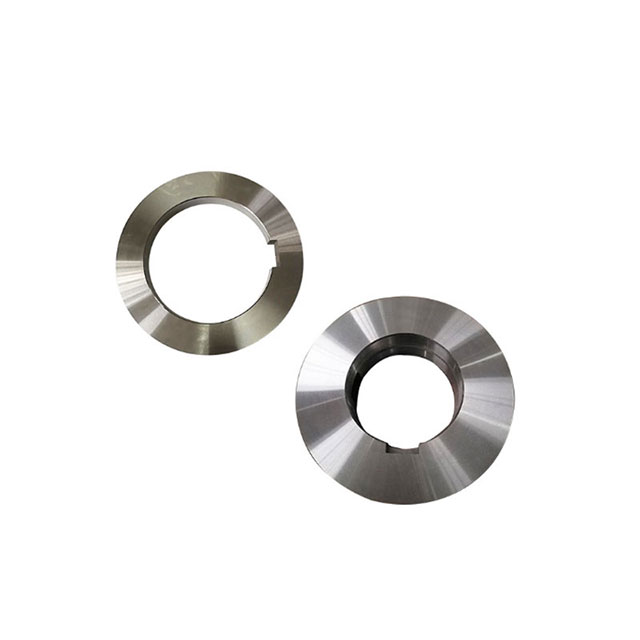
Slitter Slitter Blade Adjustment Technology
Slitter slitter blade adjustment technology is critical to ensuring efficient and precise operation of the slitter. Blade adjustment requires a series of steps and precautions to ensure the blades are adapted to the various metal coil materials and thicknesses, achieving optimal cutting results. These techniques encompass not only blade selection, installation, and adjustment, but also the optimal configuration of key components such as spacers (gap washers) to optimize cutting quality and production efficiency. When adjusting the slitting machine blades, for example, with a coil thickness of 1 mm, the blade gap should be set to 20 s. Specifically, the first blade in the upper row should be a full-size 580, and the second should be (550+8+1.8). The lower row should be adjusted accordingly. During installation, ensure that the 20 s blade faces outward, and the full-size blade faces inward. After installation, the machine should be driven into the archway and the blades should be aligned. Note that the blades should not be fully engaged before alignment; appropriate clearance should be left. Only after the blade gap is fully balanced can the blades be fully lowered, ensuring that the engagement depth approximates the coil thickness. Furthermore, the high-precision tungsten steel circular slitting knives used in the transformer core industry, with their stringent cutting requirements, are key products we have specifically developed and manufactured. These knives not only offer excellent wear resistance and machining accuracy, but also a long service life and a high cost-effectiveness, making them an ideal choice for users in the core industry to reduce slitting costs and improve slitting quality. At the same time, we also produce various specifications of high-precision tungsten steel circular cutting tools, which are widely used in the high-precision slitting of non-ferrous metal materials such as copper and aluminum in the electronics industry, silicon steel sheets, and packaging industry materials.