

Is Your Shredder Blade Good Enough?
Core Performance and Practical Advantages Explained
In various shredding operations such as wood processing, solid waste recycling, plastic shredding, and agricultural straw treatment, shredder blades are the core component of the equipment, directly determining the overall operating efficiency, finished product quality, and production costs. Many users wonder why some shredders are stable and high-yielding with low consumable costs, while others frequently jam, produce uneven powder, and require frequent blade replacements. The core difference lies in the quality and compatibility of the blades. Today, we’ll take a comprehensive look at the real-world performance of high-quality shredder blades to help you avoid common selection and usage pitfalls.
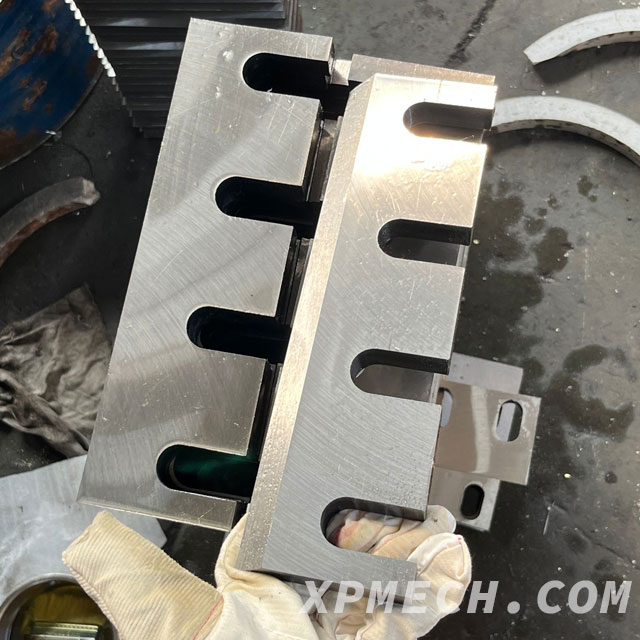
I. High-Efficiency Shredding, Uniform and Impurity-Free Finished Products
The core function of shredder blades is to rapidly crush various materials through a combination of shearing, compression, and tearing mechanical principles. High-quality blades, with precisely optimized cutting edge angles, offer low cutting resistance and strong clamping force, enabling rapid shredding of everything from soft and hard wood, plastic granules, chemical fiber waste, to crop straw and thin metal scraps.
Compared to ordinary, inferior blades, high-quality alloy blades can increase crushing efficiency by 10%-15%, eliminating problems such as material jamming, clogging, and incomplete crushing. The finished product particles are uniform in size, with no long strips or large pieces of residue, significantly reducing dust generation. This meets the material standards for subsequent processing, optimizes the workshop working environment, and adapts to the needs of refined production. In continuous operation tests with high-fiber, high-toughness materials, the material forming rate after processing with high-quality blades far exceeds that of ordinary blades, effectively improving the finished product qualification rate.
II. Wear-resistant and durable, significantly reducing blade replacement frequency
Rapid wear, easily dulled edges, and short lifespan are the most prominent problems of inferior crusher blades, and the main reason for increased production downtime costs. High-quality crusher blades on the market mostly use premium materials such as SKD11 high-speed steel, cemented carbide, and high-manganese alloy. They undergo multiple high-temperature heat treatment processes such as quenching and tempering, achieving a cutting edge hardness of approximately 65HRC, far exceeding the 55HRC standard of ordinary carbon steel blades, significantly improving wear resistance and impact resistance.
Actual test data shows that after continuously pulverizing 500 kg of high-fiber material, the wear rate of high-quality alloy blades is less than 2%, while that of ordinary blades exceeds 15%. In typical industrial operations, high-quality blades have a lifespan of 12-18 months, compared to only 3-6 months for ordinary blades, representing a several-fold increase in lifespan. Furthermore, high-quality blades are impact-resistant, less prone to chipping, and less susceptible to deformation, allowing for stable operation even with hard, irregular materials. This completely eliminates the hassle of frequent downtime for blade replacement and sharpening, effectively increasing equipment uptime.
III. Energy Saving and Noise Reduction, Saving Long-Term Production Costs
Many users easily overlook the impact of blades on equipment energy consumption. Dull, worn, or poorly designed blades result in extremely high cutting resistance, requiring the equipment to operate under overload to complete the pulverizing operation. This not only causes a surge in power consumption but also accelerates the wear and tear on core components such as motors and bearings, significantly increasing the equipment failure rate.
In contrast, high-quality blades in good condition provide smooth cutting with low resistance, effectively reducing the equipment’s operating load and minimizing ineffective energy consumption. According to industrial measurement data, when processing waste of the same specifications, shredders equipped with high-quality blades can reduce power consumption by approximately 40%, while also reducing operating noise and vibration, effectively slowing down equipment aging. Over long-term operation, this not only saves significant electricity costs but also reduces additional expenses for equipment maintenance and parts replacement, resulting in an overall reduction of approximately 30% in consumables and maintenance costs.
IV. Strong Adaptability, Stable Operation in Multiple Scenarios
High-quality shredder blades are not a single universal design but rather feature a refined structural design tailored to different material characteristics and equipment models. Wood shredder blades have an optimized tooth shape structure for better drag reduction and cutting performance, suitable for shredding hardwoods, mixed woods, and wood chips; solid waste shredding blades have enhanced overall strength, are tear-resistant and impact-resistant, and can handle plastics, rubber, and industrial waste; agricultural shredder blades are suitable for lightweight materials such as straw and vines, providing better shredding and spreading effects.
Precise structural design allows the blades to perform optimally in their respective scenarios, eliminating the problems of large materials not being pulverized and small materials being over-pulverized. It balances operational efficiency and finished product quality, adapting to various scenarios such as mass production in factories, small-scale processing, and agricultural operations.
V. Routine Maintenance to Maintain High Blade Efficiency
To maintain the high-quality performance of the blades in the long term, routine maintenance is essential. Before operation, remove hard impurities such as nails and stones from the materials to prevent chipping of the cutting edge; regularly check the wear of the cutting edge, and sharpen it promptly if it becomes slightly dull to prevent further wear and reduced efficiency; after operation, clean any residual material from the blade surface and apply rust prevention treatment; periodically disassemble and maintain the blades according to the operating scenario to ensure secure installation and precise engagement.
Summary
While the pulverizer blades may seem like small accessories, they are crucial for controlling production efficiency, finished product quality, and maintenance costs. High-quality blades not only provide faster pulverization speeds and more uniform finished products, but also offer extended service life, lower energy consumption, and fewer downtime malfunctions, fundamentally optimizing the production process and saving production costs.
By abandoning the short-term compromise of cheap and inferior blades and choosing high-quality pulverizer blades with high hardness, high wear resistance, and strong adaptability, the pulverizing equipment can operate continuously and efficiently, achieving the long-term production goal of cost reduction and efficiency improvement.