

Toothed Blades: The Ultimate Guide to Precision & Durability for Industrial Cutting
In industrial manufacturing and processing lines, cutting quality directly determines product yield, production efficiency, and operational costs. For businesses engaged in food processing, packaging, recycling, and woodworking, choosing the right serrated blades (toothed blades) is one of the most cost-effective ways to eliminate cutting defects, reduce frequent blade replacements, and stabilize long-term production output.
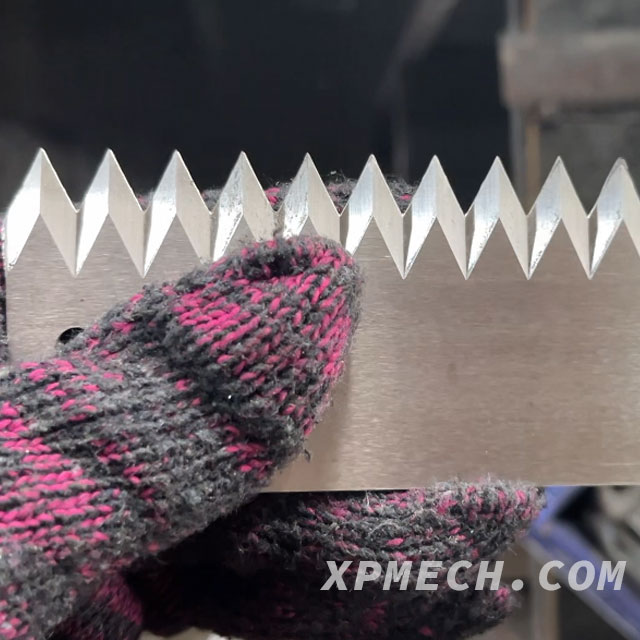
Core Advantages of High-Quality Industrial Serrated Blades
Not all serrated blades deliver consistent performance. Premium industrial-grade toothed blades stand out from ordinary civilian blades through strict material selection, precision processing, and professional heat treatment, bringing tangible value to production lines:
1. Burr-Free & Tear-Free Cutting Effect
The precisely polished tooth pitch and sharp cutting edges ensure clean slicing on various complex materials. Whether cutting flexible packaging films, thick cardboard, porous foam, rubber materials, or fibrous frozen meat and poultry products, the blades maintain neat incision surfaces without burrs, cracks, or material stretching. This greatly reduces product scrap rates and secondary processing procedures.
2. Excellent Wear Resistance & Long Service Life
High-end serrated blades adopt high-quality stainless steel materials such as SUS420 and 9Cr18MoV, with professional vacuum heat treatment and hardness controlled at 52-60 HRC. The integrated molding and CNC fine grinding process enhances the overall toughness and impact resistance of the blade. It effectively resists wear, edge chipping, and deformation during long-term high-speed continuous operation, extending service life by 2-3 times compared with ordinary blades and significantly reducing equipment downtime and replacement costs.
3. High Adaptability for Multi-Scenario Industrial Use
Industrial serrated blades have extremely strong scene compatibility and can be customized in tooth pitch, tooth shape, thickness, and outer diameter according to different equipment and cutting materials. They are widely applicable to automated cutting machines, slicers, slitting machines, and recycling crushing equipment, covering multiple mainstream industries.
4. Safe, Hygienic & Low Maintenance
Food-grade serrated blades feature smooth, non-stick surfaces that are easy to clean and sanitize, with no residual material hidden in tooth gaps. They fully comply with international food safety standards, suitable for frozen food processing, meat cutting, and central kitchen automated production. For industrial scenarios such as packaging and waste recycling, the anti-rust and anti-corrosion properties of the blades also reduce daily maintenance difficulty.
Main Application Industries of Serrated Blades
With their powerful cutting performance for tough and flexible materials, serrated blades have become essential core accessories for automated production lines:
- Food Processing Industry: Ideal for cutting frozen meat, bones, poultry, seafood, and various fibrous ingredients, solving the problems of difficult cutting and messy incision of frozen materials.
- Packaging Industry: Suitable for slitting plastic films, bubble wraps, cartons, composite packaging materials, realizing high-speed and stable cutting of packaging lines.
- New Materials & Light Industry: Perfect for cutting foam, sponge, rubber, non-woven fabrics, and flexible synthetic materials, ensuring flat and neat cutting sections.
- Recycling & Woodworking Industry: Used for cutting and crushing waste plastics, waste paper, wood scraps, and recycled materials, with strong impact resistance and stable operation.
How to Choose Qualified Industrial Serrated Blades?
Many enterprises face frequent blade dulling, edge breaking, and material wasting in production, mostly due to mismatched blade models and unqualified processing craftsmanship. When purchasing industrial serrated blades, it is recommended to focus on the following core indicators:
First, check the material hardness and toughness. Excessively hard blades are prone to chipping, while overly soft blades are easy to deform and dull. High-quality stainless steel with standardized heat treatment can balance hardness and toughness perfectly.
Second, confirm the tooth shape and pitch customization. Different materials require matching tooth densities: fine teeth are suitable for thin films and precision cutting, while coarse teeth are more suitable for thick, hard, and frozen materials to improve cutting efficiency.
Third, verify processing precision and quality control. High-precision CNC grinding ensures uniform tooth spacing and smooth blade surface, avoiding unbalanced blade operation and abnormal equipment vibration caused by processing errors.
Final Thoughts
In automated industrial production, small blades play a decisive role in production efficiency and product quality. A high-quality serrated blade can not only improve cutting speed and product qualification rate but also greatly reduce long-term equipment maintenance and replacement costs, creating stable economic benefits for enterprises.
We support one-stop customized services for serrated blades, including personalized customization of material, size, tooth shape, and hardness, adapting to various brand equipment and industry scenarios. All products pass strict quality testing, with stable performance and reliable after-sales service.
Contact us now to get professional blade selection solutions and bulk preferential quotations!