

Technical Parameters for Selecting Slitting Blades
Selecting slitting blades requires attention to five key dimensions: blade geometry adapted to material characteristics, dynamic balance accuracy of G2.5 or higher, targeted surface treatment technology, efficient thermal management system, and intelligent monitoring interface. Parameter combinations are validated through 72-hour operating condition testing to achieve optimal slitting results.
When selecting slitting blades, in addition to basic technical parameters, the following key dimensions should be considered in conjunction with the specific application scenario:
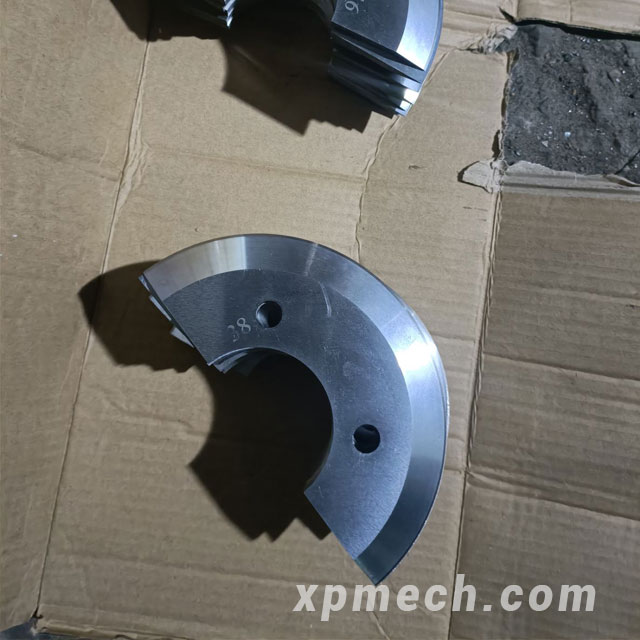
- Adaptability of Blade Geometry: Different materials have different requirements for blade angle design. For example, slitting PE film requires a sharp blade angle of less than 20° to reduce material tensile deformation, while processing carbon fiber composites requires an obtuse angle design of more than 40° to enhance the blade’s resistance to chipping. Advanced laser cutting blades even employ asymmetrical blade designs, achieving a “push-cut” effect through combinations of different angles on the upper and lower blade surfaces, significantly reducing slitting resistance.
- Dynamic Balance Accuracy Level: High-speed slitting machines (linear speed > 800m/min) require blades with a dynamic balance level of G2.5 or higher. A German brand, through its titanium alloy bushing counterweight technology, can control the radial runout of a 6mm thick cutting blade to within 0.003mm. This level of precision effectively avoids high-frequency vibrations during slitting, extending bearing life by up to 30%.
- Surface Treatment Technology Selection
CrN coating can improve blade wear resistance by 3 times, but aluminum layer adhesion may occur when processing PET aluminized film. In this case, diamond-like carbon (DLC) coating is more suitable, with a friction coefficient as low as 0.1, making it particularly suitable for slitting composite materials with adhesive coatings. A gradient coating technology developed by a Japanese manufacturer, by setting a transition layer between the substrate and the coating, increases the coating bonding strength to over 80N. - Thermal Management Performance Indicators
When continuously slitting engineering plastics, blade temperatures may exceed 300℃. Cutting blades with a copper core composite structure have a thermal conductivity of up to 380W/(m·K), and with a forced air cooling system, the cutting zone temperature can be stabilized below 150℃. A Swiss manufacturer’s cutting blades incorporate micro heat pipes, utilizing phase change heat transfer to reduce hotspot temperatures by 50°C within 0.5 seconds. - Compatibility of Intelligent Monitoring Interfaces Modern intelligent slitting lines require cutting blades to integrate RFID chips or strain sensors for real-time wear data transmission. For example, a US brand’s intelligent cutting blades can transmit cutting force fluctuation maps via Bluetooth. Combined with AI algorithms, this can predict edge failure points up to 2 million cuts in advance, improving tool change timing accuracy to ±15 minutes.
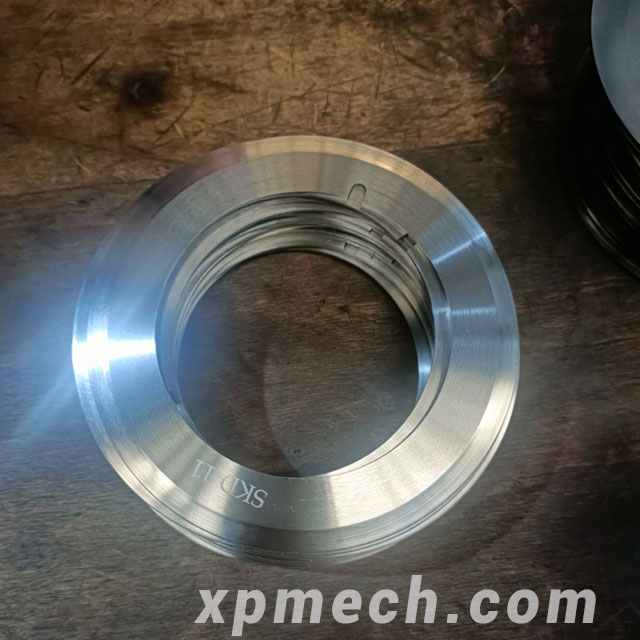
The selection of these advanced parameters requires a systematic analysis of material properties, equipment conditions, and process requirements. It is recommended to conduct at least 72 hours of actual operating condition simulation testing before procurement, recording the slitting cross-section quality using a high-speed camera and analyzing edge element migration using an energy dispersive spectroscopy (EDS) analyzer to ultimately determine the optimal parameter combination.